
Noticias
23 of April,2025
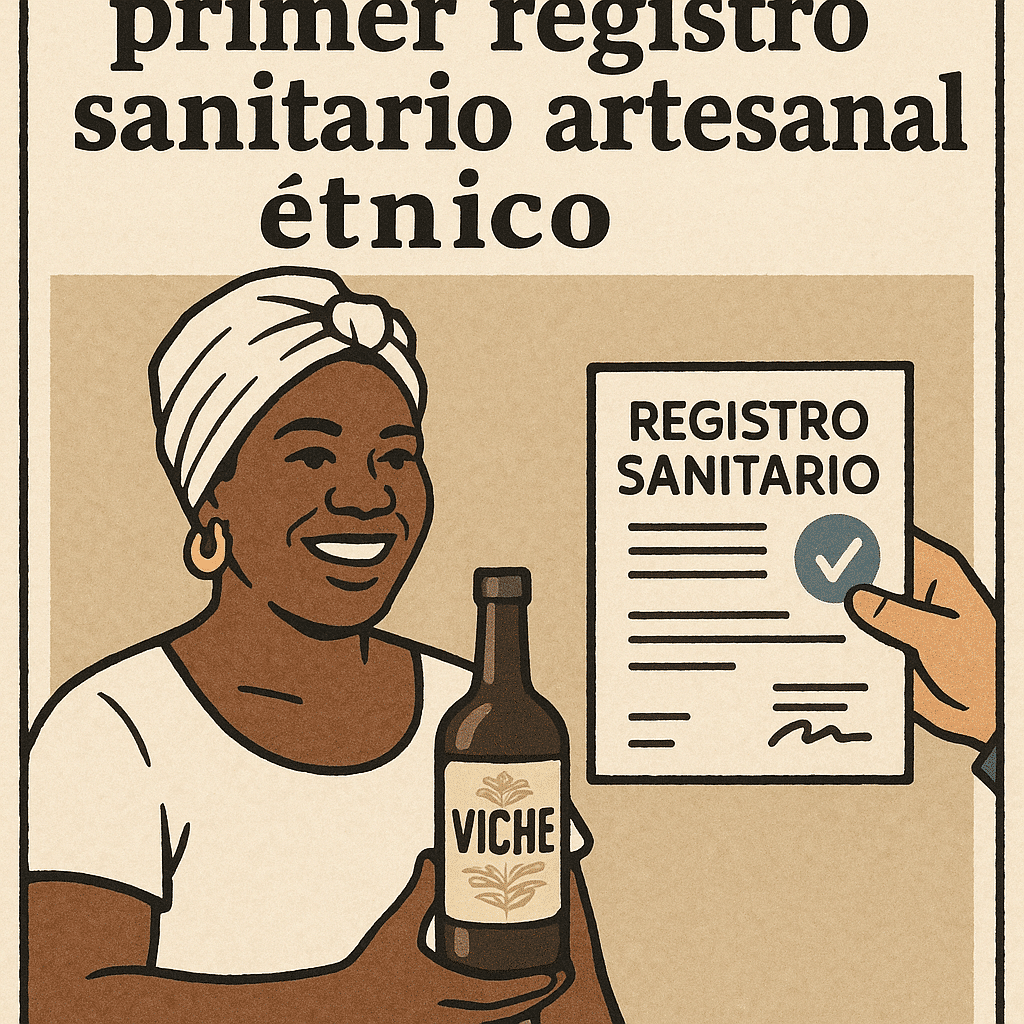
El Viche obtains its first ethnic artisanal Market Authorization
Por: Carlos Conde-Gutiérrez - Docente Investigador (PhD)
Viche, an ancestral, spiritual and cultural drink of the communities of the Colombian Pacific, has just taken a big step: Maestro Onésimo González Biojó obtained the first market authorization under the category “Ethnic Artisanal” granted by INVIMA, Colombian national health authority.( Paez , 2025) This is not only a recognition of Master Onésimo, but an important milestone in the commercialization of a product with clear cultural roots and traditional knowledge, as it is expected that this registration will be just the first of many.
What is Viche?
According to Law 2158 of 2021, or Viche Law, this is a “drink made ancestralously and artisanally by the black communities of the Pacific, obtained from the non-industrial distillation, through ethnic mills, of the fermented juice of sugar cane, with characteristics of the cane of each Pacific region.”
The same law states that only members of Afro-descendant communities who live on the Colombian Pacific coast and are bearers of the tradition can advance its production and transformation. These aspects are developed in more detail in Decree 1456 of 2024, which regulates Law 2158 of 2021.
The road to legal recognition
For decades, the production and marketing of Viche was marginalized, seen as illegal or informal (VLex, 2024) . But the moment that set off the alarms was in 2017, when a person outside the Afro-Colombian communities of the Pacific obtained a trademark for “Viche del Pacifico”, which represented a clear example of cultural appropriation of a community. Although the discussion of what cultural appropriation is goes beyond the scope of this article, it can be said that it occurs when a third party ”appropriate” something that is the cultural relevance for a community or people without their consent (Berson, 2010).
The controversy led to sustained pressure from Pacific communities, culminating in the decision of the Superintendence of Industry and Commerce (SIC) to cancel the registration in 2018, considering that the term had become generic (vulgarization). Subsequently, the SIC has denied other registrations related to Viche, using the ground of non-registrability for using symbols or signs that are culturally significant for ethnic communities (Article 136 (g) of Decision 486 of 2000). (Conde Gutiérrez & Gómez Orlando, 2024; Erazo-Ramírez, 2024; Rochel, 2021)
Differential legislation for a unique product
The battle continued, and in 2021 Colombia took an important turn with the issuance of Law 2158, which recognized the Viche and its cultural landscape as intangible cultural heritage. In 2024, Joint Resolution 00113 of the Ministry of Health and the Ministry of Cultures was issued, regulating the production of pure Viche with differentiated conditions and adapted to traditional producers. For example, for five years the focus will be on ensuring that the product complies with differential sanitary standards, without requiring that the production units immediately adjust to all regulations, thus giving time for their adaptation. In addition, cultural conditions of the territory are recognized, such as not requiring drinking water – a mandatory requirement for other spirits according to Decree 1686 of 2012.
A decree to protect and promote Viche
In December 2024, Decree 1456 was issued, which regulates the Viche Law and integrates into the regulatory framework of the cultural sector (Decree 1080 of 2015) measures to safeguard, protect, promote and encourage Viche as an ancestral drink and collective heritage of the black communities of the Colombian Pacific. It also establishes the creation of a Special Plan for the Safeguarding of the Vichero cultural landscape, which already has a favorable concept from the National Heritage Council and is awaiting the issuance of the administrative act by the Ministry of Cultures (Ministry of Cultures, 2024).
The decree also allows the commercialization of Viche and its derivatives (transformations) in cultural events without the need for sanitary registration, such as the Petronio Álvarez Festival or the NegroFest. In addition, it establishes an accreditation system for traditional producers through the endorsement of the community councils, who will be the only ones authorized to obtain the sanitary registration. Finally, it creates an annual certification system of differential prices before DANE, and regulates the operation of the Inter-institutional Committee of the Viche Law, with direct representation of producers and processors from Cauca, Chocó, Nariño and Valle del Cauca, to ensure their participation in decision-making and public policies.
Pending challenge: the derivatives of Viche
Despite these advances, regulations have yet to be issued on Viche derivatives – drinks that use pure Viche as a base combined with plants and other natural resources of the territory – among which are “Toma Seca”, “Curao”, “Balsamic”, “Arrechón”, among others.
Traditional Knowledge, Intellectual Property and Health Regulation
The case of Viche demonstrates that health regulation and intellectual property can go hand in hand with traditional knowledge and the safeguarding of cultural heritage. Recognizing traditional practices, adapting to the territory and ensuring that communities can access legality without renouncing their identity is a clear example of public policy with a differential approach.
The first market authorization granted to Master Onésimo presents an interesting case study that should continue to be observed to measure the impact of health regulations, the safeguarding of heritage and the protection of ancestral knowledge.
If you want to know more about Viche, we invite you to listen to the episode “On the way to COP 16: the regulation of Viche” on Propintel Podcast:
Bibliography
Berson, J. (2010). Intellectual Property and Cultural Appropriation. Reviews in Anthropology, 39(3), 201–228. https://doi.org/10.1080/00938157.2010.509026
Conde Gutiérrez, C. A., & Gómez Orlando, J. F. (2024). El Viche en la Propiedad Intelectual: Un Análisis desde la Perspectiva Jurídica y Cultural – Departamento de Propiedad Intelectual. ProPintel. https://propintel.uexternado.edu.co/el-viche-en-la-propiedad-intelectual-un-analisis-desde-la-perspectiva-juridica-y-cultural/
Erazo-Ramírez, P.-F. (2024). From Intellectual Property to Cultural Heritage. Case study of the protection of Viche/Biche, an ancestral drink. Revista La Propiedad Inmaterial, 37, 5–35. https://doi.org/10.18601/16571959.N37.01
Ministry of Cultures. (2024). The Vichero Cultural Landscape is the protagonist at COP16. https://www.mincultura.gov.co/noticias/Paginas/el-paisaje-cultural-vichero-es-protagonista-en-la-cop16.aspx
Paez, A. M. (2025). The story behind the first viche to receive Invima registration: it is called Mano de Buey and it is made in Tumaco. https://www.eltiempo.com/cultura/gastronomia/la-historia-detras-del-primer-viche-en-recibir-registro-invima-se-llama-mano-de-buey-y-es-elaborado-en-tumaco-3445278
Rochel, K. (2021). Cancellation of the trademark registration certificate of the trademark “Viche del Pacífico” due to vulgarization. Revista La Propiedad Inmaterial, 32, 261–267. https://doi.org/10.18601/16571959.N32.09
VLex. (2024). Draft Resolution of the Ministry of Culture, declaring the Vichero/Bichero Landscape as an Asset of Cultural Interest at the National level and approving its Special Safeguarding Plan as a management instrument (28/07/2023) – vLex Colombia. https://vlex.com.co/vid/proyecto-resolucion-ministerio-cultura-940979399